
Views: 0 Author: Site Editor Publish Time: 2026-03-05 Origin: Site


The term insert in a CNC machine often confuses buyers because it is used in turning, milling, drilling, and boring, yet many people are not sure what it actually refers to. In simple terms, an insert is the replaceable cutting edge mounted on a tool body. It is the part that contacts the workpiece, removes material, and has a direct effect on finish, stability, and tool life. For customers exploring CNC tooling from NeK, understanding this concept makes it much easier to see how different tools work and why the right insert matters in daily machining.
An insert is not the entire tool. It is the cutting part fixed onto a holder, cutter body, or drilling tool. The machine spindle drives the tool, but the insert performs the actual cutting. That is why inserts are such an important part of CNC machining.
The main advantage is simple. When the edge becomes worn, the user changes the insert instead of replacing the full tool. This makes maintenance easier and keeps the cutter body in service longer. In production work, that saves time and helps control tooling cost.
An insert is also designed for a specific purpose. Its shape, cutting edge, and grade are chosen according to the material and operation. Because of that, inserts should never be treated as generic parts.
Inserts are widely used because they support cost control, stable performance, and faster tool changes. In a busy workshop, reducing machine stoppage is valuable. When inserts can be indexed or replaced quickly, production becomes smoother.
They also improve repeatability. With the right insert, users can maintain more consistent cutting performance across larger production runs. This is especially important in industries where part quality and delivery reliability matter.
For many customers, inserts also improve tool economy. A multi-edge insert gives more usable cutting edges before the insert is fully consumed. That is one reason inserts are standard in modern metalworking and why suppliers like NeK offer insert solutions for different machining tasks.
Turning inserts are used on lathes and turning centers. In turning, the workpiece rotates while the tool removes material from the outside diameter, face, or profile of the part. These inserts are commonly used for cylindrical parts and continuous cutting operations.
Milling inserts are especially important because milling is used in many everyday machining operations. In milling, the cutter rotates and the insert enters and leaves the cut repeatedly. This interrupted cutting action creates impact and thermal cycling, so milling inserts need strong edge integrity and good toughness.
They are commonly used for face milling, shoulder milling, slotting, chamfering, and general surface machining. For many buyers, a CNC milling insert is one of the most relevant insert categories because it has a direct effect on productivity in practical manufacturing work.
Drilling inserts are used in indexable drills for efficient hole making, while boring inserts are used to enlarge and finish internal diameters. These tools follow the same basic principle: the insert is the replaceable cutting edge, while the tool body provides support and positioning.
Insert Type | Machine or Tool | Main Operation | Typical Buyer Need |
Turning insert | Lathe or turning center | Turning and facing | Stable cutting on round parts |
Milling insert | Milling cutter | Face milling, shoulder milling, slotting | Better efficiency and easy edge replacement |
Drilling insert | Indexable drill | Hole making | Faster drilling and lower maintenance cost |
Boring insert | Boring tool | Internal diameter finishing | Improved hole accuracy |
A milling insert works as part of a larger cutting system. The spindle holds the tool holder, the holder supports the cutter body, and the cutter body contains the insert pockets. Once mounted, the inserts become the active cutting edges. As the cutter rotates, each insert contacts the workpiece and removes material.
This explains why insert performance depends on the overall setup. Even a good insert may not perform well if the machine lacks rigidity or the cutter body is poorly matched. Still, the insert remains the part that most directly affects cutting quality because it forms the chip and carries the cutting load.
Milling inserts work under repeated interruption. They strike the material, leave the cut, and re-enter again. This creates impact loads and heat cycles that are different from the more continuous cutting of turning.
Because of that, milling inserts need a strong balance between toughness and cutting ability. If the edge is too weak, it may chip. If it is too heavy for the application, cutting forces may rise and reduce stability. This is why milling insert selection has such a strong influence on machining performance.
The first question is what material is being cut. Steel, stainless steel, cast iron, and non-ferrous materials all place different demands on the insert. The second question is the operation. Face milling, shoulder milling, and contouring do not require exactly the same insert behavior.
Buyers should also consider cutter size, machine rigidity, and production volume. Larger cutters and repeated production usually make insert systems more attractive because quick edge replacement becomes more valuable.
A CNC milling insert is often the better option when a job involves repeated shoulder milling, broad surface face milling, or batch production with frequent edge wear. In these cases, replaceable inserts reduce downtime and make maintenance more efficient.
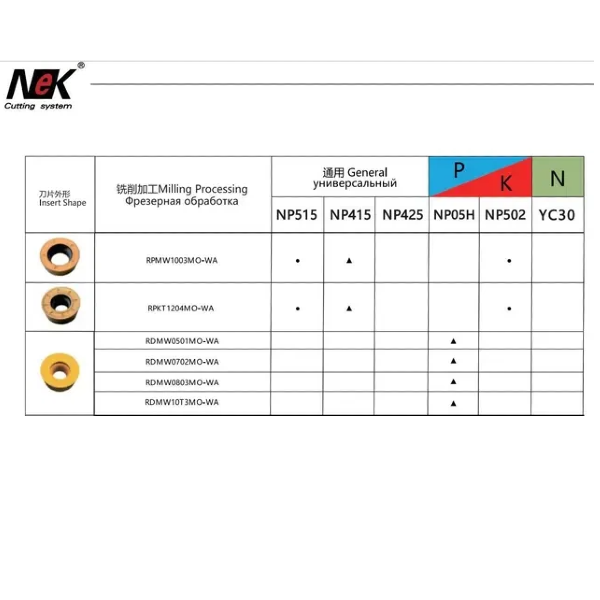
This is also where product range matters. Different jobs require different insert styles, which is why NeK offers models such as WNMU080608EN, APMT1135PDER, and RPKT1204MO for different milling needs. A wider range helps buyers match the insert to the job more accurately.
One common misunderstanding is that any insert that fits the tool will work well. In reality, geometry, grade, coating, and application all matter. An insert that performs well in one material or operation may perform poorly in another.
That is why insert selection should always begin with the cutting task, not just the insert size. A correct match improves stability, finish, and tool life.
A low purchase price does not always mean lower machining cost. If an insert causes chatter, unstable finish, short tool life, or wasted parts, the overall cost rises quickly. In real production, poor fit often costs more than buyers expect.
A better-matched insert may last longer, cut more smoothly, and reduce interruptions. That improves cost per part, which is usually more important than unit price alone.
The phrase insert in a CNC machine covers several tooling categories, but the meaning is straightforward: an insert is the replaceable cutting edge that makes controlled machining possible. Among these categories, milling inserts are especially important because they affect productivity in many of the most common machining operations. NeK provides insert solutions for practical industrial applications, helping customers compare products based on real machining needs rather than price alone. If you are reviewing options for your next job, a suitable CNC cutting insert such as RPKT1204MO can help improve stability, tool life, and daily efficiency. Contact us to discuss your application and find the right insert solution.
It is the cutting edge mounted on a tool body. It removes material, forms chips, and directly affects surface finish, tool life, and cutting stability.
No. The insert is only the cutting part. The full cutting system also includes the holder, cutter body, and machine spindle.
They are widely used because they support face milling, shoulder milling, slotting, and other common operations while allowing fast edge replacement and better production efficiency.
You are more likely to need one when your job involves repeated milling operations, larger cutters, or production work where frequent edge replacement is expected.


