


A worn-out edge on hardened steel is often the moment buyers start asking what a CBN insert really is. Standard carbide can work well in many jobs, but once hardness rises and wear becomes too aggressive, CBN enters the conversation as a high-performance option for difficult materials. That does not mean it is the right answer for every cutting task. For customers visiting NeK, the more useful question is not simply what CBN is, but when it truly deserves its place in the process and when a carbide insert remains the smarter and more economical choice. CBN is widely described in technical sources as an extremely hard, thermally stable cutting material used for hardened steels, cast irons, and other difficult applications.
CBN stands for cubic boron nitride. In practical machining terms, it is one of the hardest cutting materials used in metalworking, developed for applications where ordinary insert materials may wear too quickly or lose stability under heat. It is valued because it combines extreme hardness with strong thermal stability, which makes it useful in demanding hard-material work. Technical references from major tooling manufacturers describe PCBN grades as sintered materials based on cBN powder and ceramic binders, created specifically for very hard and thermally stable cutting tools.
CBN behaves differently from carbide because it is usually selected for a narrower, more demanding range of machining conditions. Carbide is highly versatile and remains the standard choice for a large share of turning and milling work. CBN, by contrast, is chosen when hardness, heat, and wear resistance become the main challenge. It is especially associated with hardened ferrous materials and finishing-oriented work where edge life and dimensional consistency matter. Sandvik notes that CBN grades are largely used for finish turning hardened steels above 45 HRC and can replace grinding above 55 HRC, while Seco emphasizes hot hardness, oxidation resistance, and long tool life.
A CBN insert is mainly used for machining hardened steels, certain cast irons, and other wear-intensive materials where ordinary insert wear may become too fast or too costly. This is the type of job where CBN can justify its price. The material is not bought just because it sounds advanced. It is bought because the process needs a cutting edge that can survive demanding conditions without losing accuracy too quickly.
Typical use cases include hardened shafts, bearing-related parts, hardened rings, cast iron components, and similar workpieces where dimensional control and edge life matter. For these jobs, CBN can help support steady production and better finish quality when the setup is stable enough. Technical sources consistently position CBN around hardened steels, pearlitic cast iron, hard iron, and similar high-wear applications.
CBN is often discussed together with hard turning because that is one of its best-known applications. In some situations, it can replace grinding, especially where hardened steel components need accurate finishing and good repeatability. That does not mean every hard part should automatically move to CBN. It means the material becomes especially attractive when a shop wants to machine hardened material efficiently while maintaining finish and dimensional control.
This is where buyer understanding becomes important. CBN is not usually a general-purpose upgrade. It is a targeted solution for a specific level of cutting difficulty. When used in the right conditions, it can improve process efficiency. When used in the wrong conditions, it can add cost without creating enough value.
Factor | CBN Insert | Carbide Insert | Better Choice When |
Hardness capability | Very strong on hardened ferrous materials | Broad everyday versatility | CBN for hardened work, carbide for general work |
Heat resistance | Excellent at high cutting temperature | Strong but more general-purpose | CBN for severe thermal conditions |
Cost | Higher purchase cost | More economical | Carbide for routine production |
Application range | Narrower and more specialized | Wider and more flexible | Carbide for common milling and general metal cutting |
Best fit | Hard turning and difficult wear cases | Daily milling and broad machining tasks | Depends on workpiece and operation |
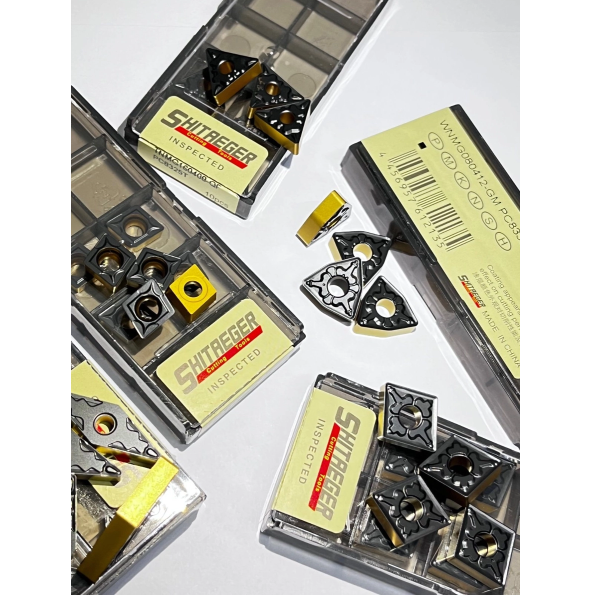
A CBN insert makes sense when the workpiece is hard enough, the operation is stable enough, and the production value is high enough to justify the insert cost. Long production runs, hardened workpieces, strong dimensional requirements, and finish-sensitive jobs are the situations where CBN earns attention. If the insert can hold size, resist wear, and reduce secondary finishing, its higher price may be justified by lower cost per part.
Stable setups matter a great deal here. CBN performs best when the machine, fixturing, and cutting conditions support the insert properly. In the right environment, it can deliver both edge life and process confidence.
For many buyers, this is the more important part of the discussion. CBN is not the best answer for general milling work, broad routine machining, or jobs that do not involve truly hardened material. In automotive, aerospace, and general manufacturing, many daily tasks are still handled more economically with well-matched carbide inserts. NeK’s milling insert range is built around this practical reality, offering carbide insert models for common milling operations where durability, efficiency, and smoother cutting matter more than extreme hardness capability. NeK’s milling insert pages position these carbide products for automotive, aerospace, and general manufacturing and describe them as wear-reducing, efficiency-oriented solutions.
That is why buyers should be careful not to treat CBN like a universal upgrade. If the job is regular face milling, shoulder milling, slotting, or routine production on common materials, carbide is often the more sensible route. It offers wider flexibility, lower cost, and better fit for everyday CNC work.
CBN performance depends heavily on how hard the workpiece really is and how stable the cut remains during machining. Hardness level changes the wear behavior of the insert, while cutting stability affects whether the edge works efficiently or fails too soon. This is one reason CBN is so often associated with hard turning and controlled finishing environments rather than loosely defined, general-purpose cutting.
Interrupted cutting also matters. If the edge enters and exits the cut under unstable conditions, the benefits of CBN may not be fully realized. Technical sources emphasize that CBN performs best in the right hardness range and under conditions stable enough to support its intended function.
Another important point is that CBN is not one simple material choice. Different grades and edge preparations are developed for different kinds of work. Some are better suited to harder materials, some to more wear-focused jobs, and some to more stable finishing applications. This means the real decision is not just whether to use CBN, but which type of CBN and whether the application truly fits it.
For buyers, the practical lesson is simple. A hard material alone does not guarantee that CBN is the best answer. The cutting style, workpiece condition, setup stability, and production target all influence whether it will perform as expected.
A useful question for buyers is whether the problem is truly material hardness or simply poor insert matching. Sometimes a shop moves toward CBN because carbide life is disappointing, but the real issue may be that the geometry, grade, or coating of the carbide insert is not well suited to the task. In other words, the process may not need a premium hard-material solution. It may need a better-matched carbide insert.
This is especially relevant for milling work. Many general production jobs are better improved by selecting the correct carbide milling insert rather than jumping directly to CBN. That approach is often more practical, more economical, and easier to apply across multiple operations.
The smartest comparison is not insert price by itself, but cost per part. A more expensive insert can still be the better choice if it lasts significantly longer, improves consistency, and reduces downtime. At the same time, an expensive insert is a poor investment if its advantages do not match the actual job.
That is why buyers should compare tool life, finish stability, interruption risk, and productivity together. For many hardened applications, CBN may justify its cost. For many standard milling tasks, a carbide insert remains the better business decision. NeK’s product range is well suited to this second category, where consistent daily performance and reasonable cost matter most for real production work. NeK lists carbide milling insert options such as WNMU080608EN, APMT1135PDER, and RPKT1204MO for these types of applications.
A CBN insert is a high-performance solution for hardened materials, not a universal answer for every cutting problem. Buyers should first define the workpiece hardness, cutting stability, and production goal, then decide whether a CBN insert is truly necessary or whether a carbide alternative will do the job more efficiently. For many general milling tasks, the better path is still a well-matched carbide solution from a practical supplier like NeK rather than an unnecessarily expensive hard-material grade. If your application involves routine milling rather than severe hard turning, a reliable APMT1135PDER option may be the smarter direction. Contact us to discuss your application and find the right insert solution for your production needs.
A CBN insert is mainly used for hardened steels, certain cast irons, and other wear-intensive materials where ordinary insert materials may wear too quickly.
No. CBN is better only in specific hard-material applications. Carbide remains the more practical and economical choice for many common milling and general machining jobs.
Because CBN performs especially well in stable hard-turning applications where finish quality, dimensional consistency, and wear resistance are critical.
They should compare cost per part, tool life, finish consistency, and production stability, not just the purchase price of the insert.


